Best Mandolin Tuners: Clip-On Picks for Every Budget
For most mandolin players, the best tuner is a small clip-on chromatic tuner that reads string vibration through the headstock. Our pick for most players is the D’Addario NS Micro Headstock Tuner: it is inexpensive, accurate to a stated 0.3 cents, and small enough to leave on the instrument. If you want the most precise tuning you can clip on, and a preset built for mandolin, the Peterson StroboClip HD costs about three times as much and is worth it for many serious players.
Below we explain why those two stand out, which cheaper and rechargeable options are worth a look, which popular feature is useless on a mandolin, and how to get a clean reading on eight strings that come in pairs.
Disclosure: MandolinExpert.com is a participant in the Amazon Services LLC Associates Program and other affiliate programs. If you buy through a link on this page, we may earn a commission at no extra cost to you. See our disclosure page for details.
How we chose: we have not bench-tested these tuners ourselves. Our picks are based on manufacturer specifications, retailer listings, published reviews and what mandolin players report using on forums such as the Mandolin Cafe. The full method and sources are at the end of this guide.
Quick picks
- Best for most players: D’Addario NS Micro Headstock Tuner (PW-CT-12), about $22
- Best for precision: Peterson StroboClip HD (SC-HD), about $60
- Best budget pick: D’Addario Eclipse Headstock Tuner (PW-CT-17), about $18
- Best rechargeable: Snark ST-2 RE Super Tight, about $21 to $23
Mandolin tuners compared
| Tuner | Type | Stated accuracy | Calibration range | Power | Typical price |
|---|---|---|---|---|---|
| D’Addario NS Micro (PW-CT-12) | Clip-on, chromatic, vibration | 0.3 cents | 410 to 480 Hz | Coin cell (see note) | $21.99 |
| Peterson StroboClip HD (SC-HD) | Clip-on strobe, piezo pickup | 0.1 cents | 390 to 490 Hz | CR2032, not rechargeable | $59.99 |
| D’Addario Eclipse (PW-CT-17) | Clip-on, chromatic | Not published | Not published | Battery, auto power-off | $17.99 |
| Snark ST-2 RE Super Tight | Clip-on, chromatic, vibration plus mic | Not published | 415 to 466 Hz | Rechargeable | $20.94 to $22.99 |
| Korg Pitchclip 2+ | Clip-on with strobe modes | 0.1 cents (strobe modes) | 436 to 445 Hz | CR2032, about 18 hours | Check availability |
Prices are the list prices we found at D’Addario-authorized and specialist retailers (Guitar Center, Sweetwater, Elderly Instruments, Peterson) in November 2026. They change often.
What actually matters in a mandolin tuner
Most tuners are designed with guitar in mind, and almost all of them will tune a mandolin. The differences that matter come from how the mandolin is built.
It has to be chromatic
A mandolin is tuned G-D-A-E from low to high, the same as a violin. Some cheap “guitar mode” tuners only recognize E-A-D-G-B-E, and while the open G, D, A and E notes overlap with guitar note names, they sit in a higher octave on the mandolin. A chromatic tuner simply recognizes any note, so it never gets confused. Every tuner in this guide is chromatic.
Vibration pickup beats a microphone at a jam
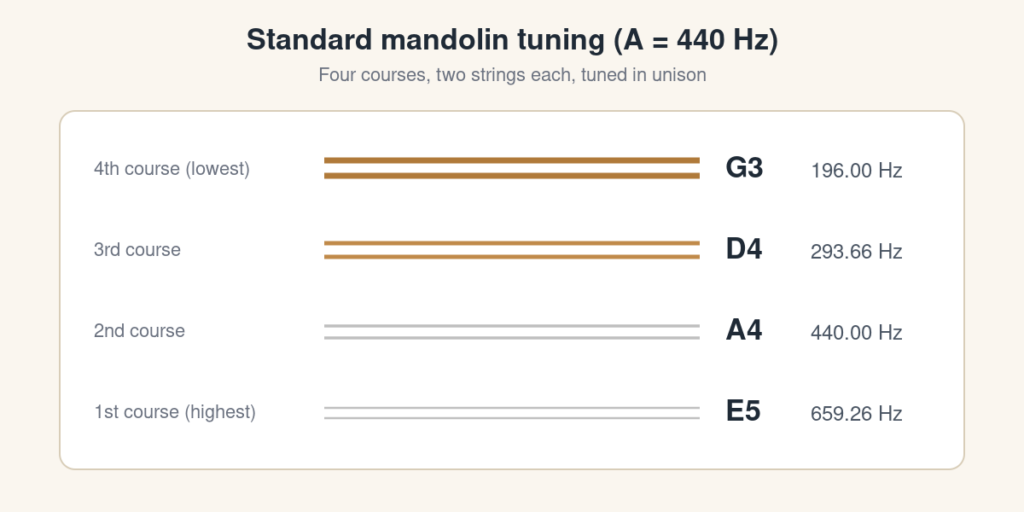
Clip-on tuners read vibration through the headstock with a piezo sensor, which means they mostly ignore the banjo player tuning next to you. Microphone-based tuners and phone apps hear everything in the room. That is fine at home, but much less useful in a bluegrass circle. The Peterson StroboClip HD has no microphone at all. The Snark ST-2 RE has both, which is handy if you also tune a horn or a voice-led instrument.
Eight strings, four notes
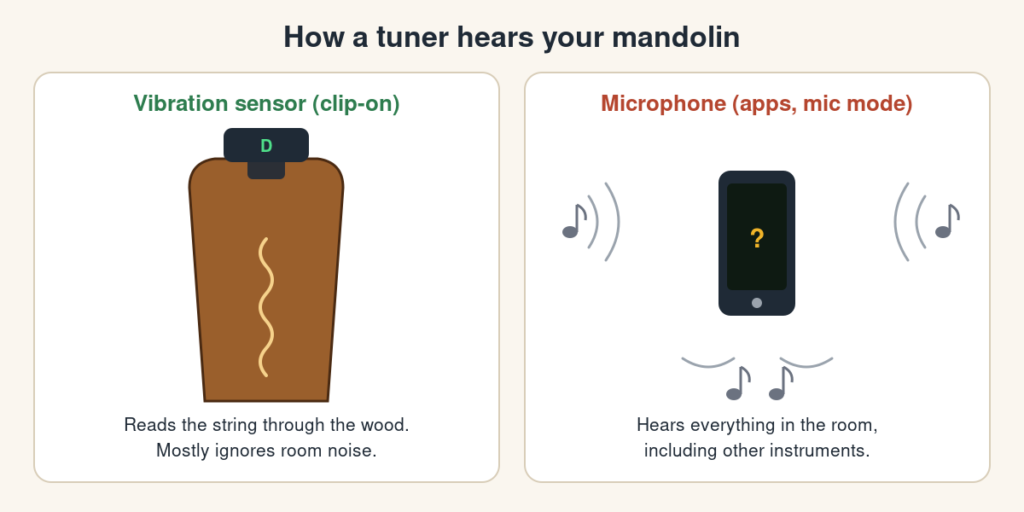
Each of the mandolin’s four courses has two strings tuned to the same pitch. A clip-on tuner cannot tell you which of the two strings it is hearing if both ring together, and two strings a few cents apart produce a wavering “chorus” sound that makes the needle jump. The fix is simple and covered in the tuning tips below: tune one string of each pair at a time.
Accuracy you can actually hear
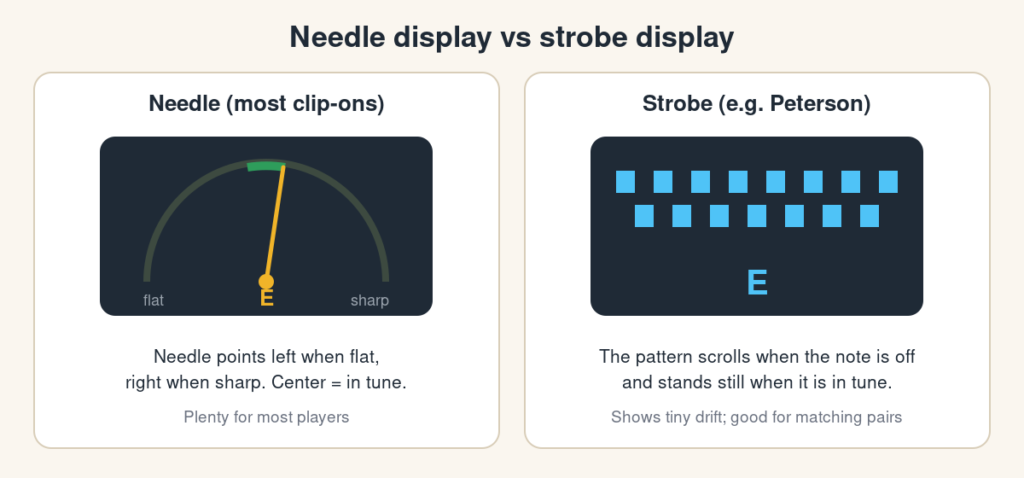
A cent is one-hundredth of a semitone. Pairs of strings that are only a few cents apart already sound slightly out of focus on a mandolin, because the two strings of a course beat against each other. That is the real reason mandolin players care about accuracy more than many guitarists do. A needle-style tuner rated at 0.3 cents is already more precise than most ears. A strobe display at 0.1 cents makes it easier to see very small drift, which helps when you are matching two strings in a course.
Headstock fit
A-style mandolins have a flat, narrow headstock. F-style mandolins have a scroll on the bass side. Small clip-on tuners usually fit both, but check that the clamp does not press on the scroll or the tuning machines, and choose a model that can sit behind the headstock if you want it out of sight. Peterson states the StroboClip HD jaw opens to more than 1 inch.
D’Addario NS Micro Headstock Tuner (PW-CT-12): best for most players
The NS Micro is the tuner we would suggest to almost any mandolin player who does not already own one. D’Addario states 0.3-cent accuracy, and it has a color display, a calibration range of 410 to 480 Hz and a visual metronome. Its clamp lets you mount it on the front or the back of the headstock and adjust the viewing angle, which matters on a mandolin, where the headstock is small and you want the tuner out of the way of your fretting hand.
MusicRadar named it an editor’s pick and described it as “inexpensive, small, and pretty damn accurate.” The reviewer also noted the two drawbacks we would expect: the small screen is harder to read on a dark stage, and like any clip-on it can struggle to register in a loud room. It also is not polyphonic, though that feature has no value on a mandolin anyway (more on that below).
On the Mandolin Cafe forum, players who use a Peterson as their main mandolin tuner still report buying D’Addario micro tuners in two-packs and leaving them on their other instruments. That is a good summary of its role: cheap enough to leave on every case, accurate enough that most players never need more.
Who should buy it: beginners, casual players and anyone who wants one tuner that stays on the mandolin.
Who should skip it: players who want strobe-level precision or a mandolin-specific sweetened tuning.
Pros: small and discreet; front or rear mounting; wide calibration range; inexpensive.
Cons: small screen in dim light; no strobe mode; battery type is listed differently by different sources (see note below).
Battery note: Guitar Center and Fiddlershop list a CR2032 coin cell, while MusicRadar’s review says CR123A. Check the packaging before buying spares.
Peterson StroboClip HD (SC-HD): best for precision
Peterson is the brand strobe tuners are known for, and the StroboClip HD puts a strobe display into a clip-on. Peterson rates it at 0.1 cents, with a backlit high-definition display, a calibration range of 390 to 490 Hz and transposition options. It reads only through a piezo pickup, so room noise does not interfere.
The feature that makes it especially relevant here is its list of 50 “Sweetened Tunings.” One of them, labeled MAN, is Peterson’s Mandolin Family Sweetener. Sweetened tunings make tiny, deliberate offsets from strict equal temperament to make common chords sound smoother on a particular instrument. Peterson does not publish the exact offsets on the product page, so treat it as something to try by ear rather than a magic setting. There is also a Fiddle sweetener (FDL), which is useful if you double on fiddle.
When mandolin players on the Mandolin Cafe name the tuner they rely on most, the StroboClip HD and its sweetened mandolin setting come up. That is anecdotal, but it fits the spec sheet.
Who should buy it: intermediate and advanced players, anyone who records, and players who are fussy about getting both strings of each course in unison.
Who should skip it: beginners on a tight budget. The NS Micro is accurate enough to learn on.
Pros: 0.1-cent strobe accuracy; mandolin sweetener preset; no microphone to pick up room noise; firmware can be updated.
Cons: about three times the price of the NS Micro; larger and heavier (Peterson lists 1.3 oz); not rechargeable. If you want a rechargeable Peterson, the StroboClip HDC adds a color display and rechargeable battery for about $80.
D’Addario Eclipse Headstock Tuner (PW-CT-17): best budget pick
The Eclipse is D’Addario’s simpler, cheaper clip-on chromatic tuner. It has a full-color vertical display, can mount in front of or behind the headstock, swivels to different angles and turns itself off to save the battery. Elderly Instruments lists it at $17.99, in several colors.
The catch is that D’Addario’s published specs for the Eclipse are thin. We could not find a stated accuracy or calibration range from a reliable source, so we cannot compare it number for number with the NS Micro. For a few dollars more, the NS Micro gives you published specs and a smaller body. The Eclipse makes sense if you want a spare for a second case or a gift for a new student.
Pros: very low price; front or rear mounting; auto power-off.
Cons: accuracy and calibration not published; larger than the NS Micro.
Snark ST-2 RE Super Tight: best rechargeable
If you are tired of coin cells, the current ST-2 is the rechargeable “RE” version of Snark’s Super Tight tuner. It has a high-definition display that rotates 360 degrees, pitch calibration from 415 to 466 Hz, flat tuning and transposition, and both a vibration sensor and a built-in microphone. Sweetwater listed it at $20.94 and Elderly at $22.99 in November 2026.
Snark does not publish a numeric accuracy figure for the ST-2, only that it is “super tight.” That does not mean it is inaccurate, but it means we cannot verify how it compares with D’Addario’s 0.3 cents or Peterson’s 0.1. Older listings for the ST-2 describe a CR2032 battery version, so make sure the one you buy says “RE” if recharging is the reason you want it.
Pros: rechargeable; mic and vibration modes; rotating display.
Cons: no published accuracy figure; mic mode picks up room noise, so leave it in vibration mode at jams.
Also consider: Korg Pitchclip 2+
The Pitchclip 2+ is a tiny clip-on (Korg says under 20 grams with the battery) with regular, strobe and half-strobe display modes. Korg rates it at 0.1 cents in the strobe modes, which on paper matches the Peterson at a much lower price. Its reference pitch only adjusts from 436 to 445 Hz, which is fine for standard tuning, and Korg says one CR2032 cell lasts about 18 hours of continuous use.
We have left it out of the main picks because availability is uneven: B&H lists it as no longer available. If you find it in stock from an authorized dealer, it is a strong budget alternative for players who want a strobe-style display.
Skip this feature: polyphonic tuning
Polyphonic tuners such as the TC Electronic PolyTune Clip let a guitarist strum all six open strings and see which ones are out. That is clever on guitar, but it is built around guitar tunings, and it does nothing useful for a mandolin’s paired G-D-A-E courses. You would only be using the tuner’s single-string chromatic or strobe modes. Those are accurate (MusicRadar reports plus or minus 0.5 cents in chromatic mode and 0.02 cents in strobe mode), but you would be paying for a feature you will never use. If you also play guitar and want one tuner for both, it is a reasonable choice. If you play only mandolin, buy a mandolin-friendly tuner instead.
What about tuner apps?
A free phone tuner app is a reasonable way to get started. Apps listen through the phone’s microphone, though, so they hear everything around them, and you need a hand free to hold the phone. For practice at home they work. For a jam, a lesson or a gig, a $20 clip-on is faster and far more reliable.
How to tune a mandolin with a clip-on tuner
These steps work with any of the tuners above.
- Clip it to the headstock so the jaws grip wood, not a tuning machine or the F-style scroll. Turn it on and, if it has modes, choose chromatic (and vibration rather than mic).
- Check the reference pitch. It should read 440 Hz unless you are tuning to a piano or a band that tunes elsewhere.
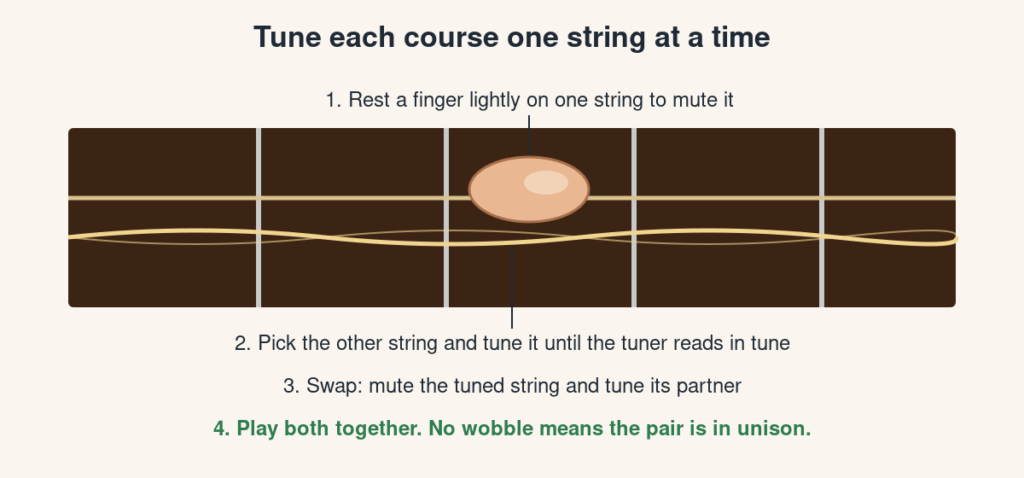
- Tune one string at a time. Rest a finger lightly on one string of the G course to mute it, pick the other string and tune it to G. Then swap: mute the string you just tuned and tune its partner.
- Tune up to the note. If you overshoot and the string is sharp, drop below the note and come back up. Tuning up to pitch helps the string settle at the tuning post.
- Repeat for D, A and E.
- Play both strings of each course together and listen. If you hear a slow wobble or “beating,” one string is slightly off. Touch up the string the tuner says is further off.
- Do a final pass. Raising or lowering one course changes the tension on the neck slightly, so check all four courses again.
For reference, these are the target notes and frequencies in standard tuning at A = 440 Hz:
| Course | Note | Frequency |
|---|---|---|
| 4th (lowest) | G3 | 196.00 Hz |
| 3rd | D4 | 293.66 Hz |
| 2nd | A4 | 440.00 Hz |
| 1st (highest) | E5 | 659.26 Hz |
New strings stretch and go flat for the first day or two, so expect to retune often after a string change. Our guide on how to change mandolin strings covers that process, including how to check that the bridge is still in the right place, which affects whether the mandolin plays in tune up the neck even when the open strings read perfectly.
Common mistakes
- Tuning both strings of a course at once. The tuner averages what it hears, and you end up with two strings that are each slightly wrong.
- Using mic mode in a noisy room. Switch to vibration mode, or use a tuner without a mic.
- Blaming the tuner for a bridge problem. If open strings are in tune but chords up the neck sound sour, check the bridge position and intonation, not the tuner.
- Leaving the clamp on a finish for months. Some players report marks from clip-on pads, especially on soft finishes. Move it or take it off when the mandolin goes back in the case.
Mechanical “tuners” are something else
Some searches for “mandolin tuners” are about the tuning machines, the geared pegs on the headstock, rather than an electronic tuner. Replacement tuning machines come in A-style and F-style sets and are a separate upgrade. If your mandolin will not hold pitch even with a good electronic tuner, worn tuning machines, new strings that are still stretching or a slipping string loop at the tailpiece are more likely causes than the tuner itself.
FAQ
Can I use a guitar tuner on a mandolin?
Yes, as long as it is chromatic. A guitar-only mode that recognizes just E-A-D-G-B-E will not reliably identify the mandolin’s notes. Every clip-on tuner in this guide is chromatic.
Do I need a special mandolin tuner?
No. There is nothing electronically different about a mandolin tuner. What matters is a chromatic mode, a vibration sensor and a clamp that fits a small headstock. The Peterson’s mandolin sweetener is the only truly mandolin-specific feature among the tuners here.
Is a strobe tuner worth it for mandolin?
For many players, yes, because matching the two strings in each course is where small errors become audible. Beginners can wait. A 0.3-cent needle tuner is already more precise than most players can hear.
Why does my tuner’s needle jump around on the mandolin?
Usually because both strings in a course are ringing and are slightly out of unison. Mute one and tune the other.
How often should I tune my mandolin?
Every time you pick it up, and again after it warms up in a new room. Temperature and humidity changes, and new strings, all move the pitch.
Our recommendation
Start with the D’Addario NS Micro. It is accurate, small and cheap enough to leave on the instrument, and it will serve most players indefinitely. If you are already a committed player, record, or simply want both strings in every course to lock together, the Peterson StroboClip HD and its mandolin sweetener are the upgrade worth paying for. If you want to avoid coin cells, the Snark ST-2 RE is the rechargeable option, with the trade-off that Snark does not publish an accuracy figure.
Once you are in tune, put it to use with our mandolin chords every beginner should know and our beginner’s guide to playing the mandolin.
How we chose these tuners
We did not buy or play these tuners for this article. We started from the clip-on tuners that specialist mandolin retailer Elderly Instruments stocks in its mandolin tuner collection, then compared manufacturer specifications from Peterson, Korg and D’Addario, retailer listings from Sweetwater, Guitar Center, Fiddlershop, StewMac and B&H, published reviews from MusicRadar and Guitar World, and what players report on the Mandolin Cafe forum. We favored tuners with published accuracy and calibration figures, vibration-based pickup for use at jams, and current availability from US retailers. Where a manufacturer did not publish a specification, we say so rather than estimate it. Prices were checked in November 2026.
Sources
- Peterson, StroboClip HD product page and specifications
- Korg, Pitchclip 2+ product page
- MusicRadar, D’Addario NS Micro Tuner review (2021)
- MusicRadar, TC Electronic PolyTune Clip review (2015)
- Guitar World, D’Addario launches the Eclipse tuner (2016)
- Guitar Center, D’Addario NS Micro Headstock Tuner listing
- Sweetwater, Snark ST-2 RE listing and Peterson StroboClip HD listing
- Elderly Instruments, mandolin tuner collection
- Mandolin Cafe forum, “Clip On Tuners / What Cha Got?”